 Back to News
 Jump to other articles:
- IN THE MEDIA: Latitude Features In Impact Wealth Magazine
- IN THE MEDIA: Latitude Features In BlockTelegraph
- Living in Argentina: What International Families Should Know
- IN THE MEDIA: Latitude Features In BusinessDay
- An Exclusive Webinar: Greece vs Portugal – Funds, Property, and Contributions Compared
Before Your Window Closes: Why Timing Matters in Residence and Citizenship Planning

Share:



Residence and citizenship planning often begins with a simple question: ‘What can I do today to help my family 10 years from now?’
The answer is likely to be multifaceted but often involves topics such as greater freedom of movement, lifestyle, family security, business opportunities, education, tax planning, and retirement. Yet, in all of this, one of the most important factors is often overlooked: timing.
It may seem an obvious statement, but residence and citizenship pathways are not permanent fixtures… and should never be treated as such.
They are, in fact, government policies and can therefore be shaped by political priorities, economic conditions, public sentiment, international scrutiny, and domestic needs. As such, they can (and do) change. Over time, programs tend to take longer and longer to obtain, become more expensive, and eventually close entirely.
For those considering a second residence, permanent residence, or citizenship pathway, there is only one way to mitigate this risk – by taking action before changes occur.
Waiting Can Feel Safe, but It Is Not Always Neutral
It is entirely human, and therefore understandable, for many individuals delay residence or citizenship planning. Jon Green, Latitude Managing Partner – North America, sees it every day.

“Some are early in their journey and are still comparing jurisdictions. Some want to eventually relocate, but are not ready to yet. Others, however, still feel comfortable in their current circumstances and are assuming they can revisit the decision at a later date,” said Mr Green.
“The problem with this last example, is that waiting is not always the neural choice it might seem. The route available today may not be available tomorrow. Investment thresholds may rise overnight. Eligibility requirements may tighten without warning. Processing timelines may lengthen. A pathway that once offered a clear route to long-term residence or citizenship may evolve into something very different.”
In most cases, explained Mr Green, the families best positioned to benefit from global mobility solutions are those who begin the process of their own free will – before a crisis, policy change, or personal trigger forces them into frantic urgency.
Governments Design Residence and Citizenship Pathways
The fact of the matter is that residence and citizenship programs exist purely because governments choose to create them.
Some are designed to attract foreign investment. Others aim to encourage entrepreneurship, strengthen capital markets, support regional development, attract highly skilled individuals, or deepen long-term international engagement.
Because these pathways are tied to national priorities, they naturally evolve.
A country may decide that a program has fulfilled its purpose. It might, for example, adjust investment requirements to reflect market conditions or even remove real estate as a qualifying route in response to housing concerns. It could also lengthen the path to citizenship due to political pressure or broader immigration reform.
This does not mean that residence and citizenship planning is unstable. It means that applicants should approach it with the same seriousness as any other long-term strategic decision.
The rules matter. Timing matters. And the ability to act while a suitable option remains available can make a significant difference.
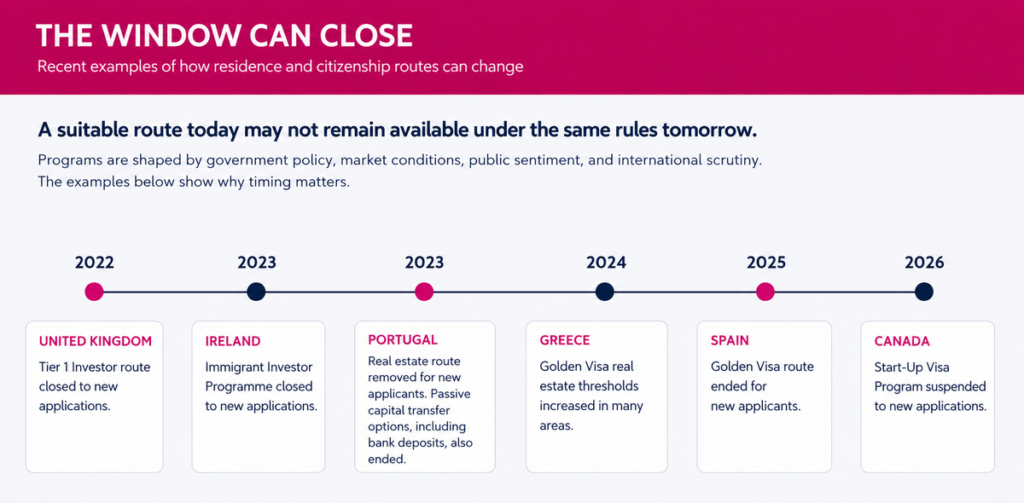
Recent History Shows How Quickly Options Can Change
Over the past several years, the investment migration landscape has changed considerably.
In 2025, Spain, once home to one of Europe’s best-known Golden Visa routes, ended this pathway entirely. For many international families who had considered Spain as a route into Europe, the opportunity is now no longer available to them.
Ireland closed its Immigrant Investor Program to new applications in 2023. The route had attracted significant international interest for more than a decade, but the government ultimately decided that the program no longer aligned with the country’s needs.
Without prior warning, the United Kingdom abruptly closed its Tier 1 Investor visa route in 2022. This was once a prominent option for high-net-worth individuals seeking residence in the UK, but the route was shut to new applicants following increased scrutiny and policy review.
Canada offers another recent example. As of January 1, 2026, Canada’s Start-Up Visa Program has been paused to most new applicants, with new commitment certificates no longer accepted after December 31, 2025. While a redesigned entrepreneur pathway is expected to emerge, industry discussions suggest that any future option may involve materially different requirements, potentially including higher investment thresholds, stricter eligibility criteria, or a more selective framework.
Changes Often Begin with Incremental Reforms
Greece also changed its Golden Visa framework in recent years, raising investment thresholds in several high-demand areas and introducing new rules around qualifying real estate. The Greece Golden Visa program remains open, but the structure is not the same as it once was.
Portugal offers another important example. The Portugal Golden Visa remains one of Europe’s most recognised residence by investment routes, but the structure of the program has changed significantly. Real estate, once the program’s most popular qualifying option, is no longer available to new applicants. Portugal also removed passive capital transfer routes, including bank deposits, meaning applicants who once may have qualified through property acquisition or a straightforward capital transfer must now consider alternative investment routes.
Malta has also seen significant change. Following legal developments at EU level, Malta moved away from its former investor citizenship route and introduced a new Malta Citizenship by Merit framework. This is not a standard investment migration program and should not be viewed as a transactional route. It is a discretionary pathway focused on exceptional contributions or value to Malta.
“These examples are not intended to suggest that every program is at risk of closure. Rather, they demonstrate a simple reality: residence and citizenship pathways evolve,” explained Jon Green.
“Applicants who assume that today’s rules will remain unchanged indefinitely may find themselves facing fewer options, higher costs, or longer timelines in the future.”
The Best Planning Happens Before the Trigger
Historically, global mobility demand has often increased in response to major events.
The COVID-19 pandemic reminded many people how vulnerable they could be if they had access to only one country. Border closures, travel restrictions, and sudden changes to entry rules made the value of alternative residence or citizenship more tangible.
Portugal offers a useful example of what can happen when demand rises sharply. During and following the pandemic, interest in the Portugal Golden Visa increased significantly, contributing to pressure on the system and long processing delays for many applicants. For families who began exploring the route only after urgency became widespread, the experience was very different from what earlier applicants may have encountered.
Political uncertainty has also driven demand. Election cycles, policy shifts, regional instability, and changes in taxation can all prompt individuals to explore additional residence or citizenship options.
But, importantly, waiting for a trigger can limit the choices available.
By the time a family urgently wants or needs an alternative, the most suitable route may have changed. Processing times may be longer. Documentation may be harder to assemble quickly. Personal or business circumstances may be more complicated. A jurisdiction that once offered a clear pathway may have introduced new restrictions.
Residence and citizenship planning is often most effective when it is proactive rather than reactive.
The strongest position is not to act out of fear. It is to understand your options while you still have time, flexibility, and choice.
Early Planning Does Not Mean Immediate Relocation
One common misconception is that exploring residence or citizenship options means preparing to move immediately.
In reality, many applicants are not seeking an urgent relocation. They are creating optionality.
A second residence or citizenship pathway may support a long-term plan involving children’s education, business expansion, retirement, family security, lifestyle diversification, or greater travel flexibility. For some, it is a Plan B. For others, it is part of a broader wealth, estate, tax, or mobility strategy.
Early planning allows families to assess what is realistic before they need to make a decision under pressure.
It can help answer important questions, including:
- Which jurisdictions are currently available?
- Which options align with our family profile?
- What are the investment requirements and timelines?
- Could the route lead to permanent residence or citizenship?
- What documentation would be needed?
- Are there tax, succession, education, or lifestyle considerations?
- How might future rule changes affect our strategy?
Having these answers in advance can make the eventual decision far more informed.
What Early Action Can Protect
Beginning the conversation early does not always mean submitting an application immediately. However, it can help families understand where they stand and what may be required if they decide to proceed.
Early planning can support:
- Eligibility assessment
- Program comparison
- Document preparation
- Family inclusion planning
- Source of funds review
- Tax and legal coordination
- Timeline management
- Jurisdiction selection
- Long-term citizenship planning
- Contingency planning
In some cases, preparing early may also allow applicants to move more quickly if a program announces a rule change, deadline, price increase, or closure.
The Caribbean Citizenship by Investment market offers a useful example. In 2024, several Caribbean jurisdictions moved to raise and harmonize minimum investment thresholds, creating a clear deadline for applicants who wanted to proceed under the previous pricing structures. As often happens when a deadline is introduced, demand increased ahead of the change, placing additional pressure on processing capacity and reinforcing the importance of preparing documentation before urgency becomes widespread.
This can be especially important in a market where government announcements may create sudden surges in demand, processing backlogs, or narrow filing windows.
The goal is not to rush into the wrong solution. It is to avoid being forced into rushed decision-making later.
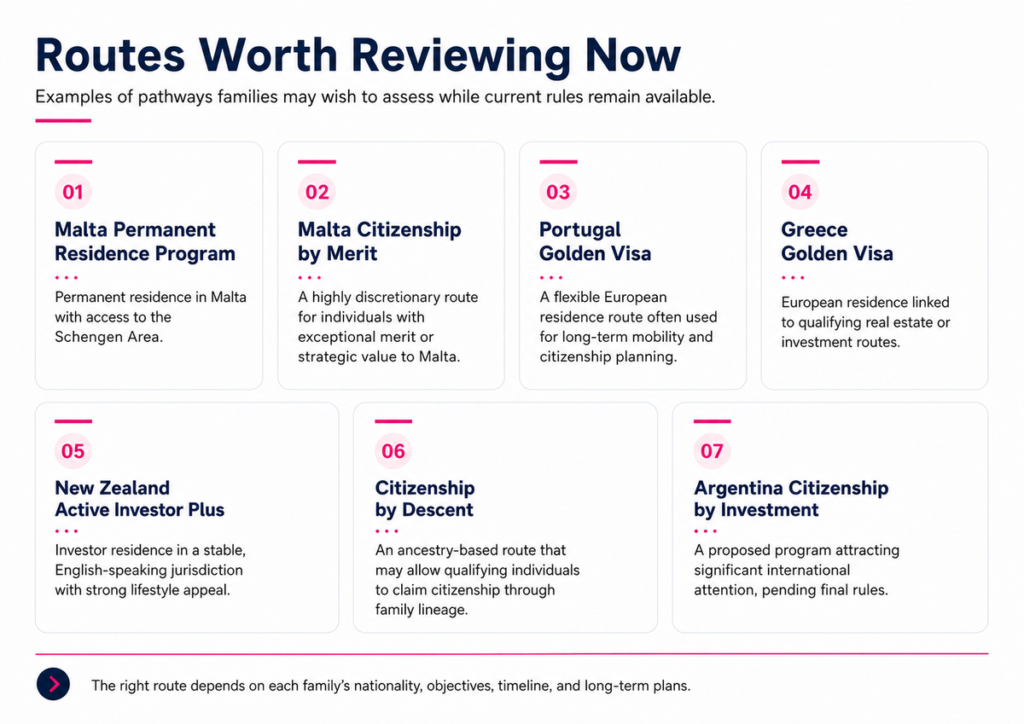
Which Residence and Citizenship Options Are Worth Reviewing Now?
The right option depends on each individual’s circumstances, objectives, nationality, family composition, timeline, and long-term plans.
For some families, the Malta Permanent Residence Program may offer an attractive route to permanent residence in a stable, English-speaking European Union member state with access to the Schengen Area.
For individuals with exceptional achievements, contributions, or strategic value to Malta, Malta’s Citizenship by Merit framework may be relevant. However, this route is highly discretionary and should not be approached as a standard citizenship by investment program.
Portugal may remain suitable for those seeking a flexible European residence route, particularly where lifestyle, long-term residence, and optionality within Europe are being considered. However, the program’s qualifying investment routes have changed significantly in recent years, so applicants should review the current requirements carefully before assuming that previously available options remain open.
Greece may appeal to applicants looking for European residence through real estate-linked options, although investment thresholds and qualifying property rules have changed and should be reviewed carefully.
New Zealand’s Active Investor Plus Visa may be relevant for investors seeking a stable, English-speaking jurisdiction with strong lifestyle appeal, geographic diversification, and long-term residence potential.
Citizenship by Descent may be appropriate for individuals with qualifying ancestry in countries such as Ireland, Italy, or other jurisdictions where nationality can be transmitted through family lineage.
Argentina’s proposed Citizenship by Investment framework is also attracting significant international attention, though final rules and operational procedures remain subject to formal confirmation by the Argentine government.
The broader point is not that one route is right for everyone. It is that each route should be assessed while the current rules are still available.
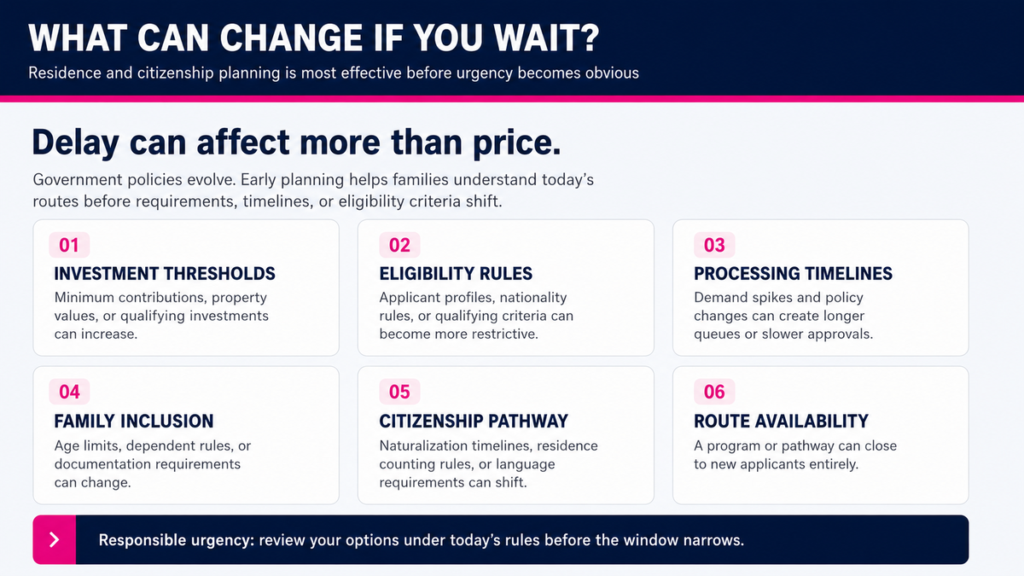
The Cost of Delay Is Not Always Financial
When people think about changes to residence and citizenship pathways, they often focus on cost.
It’s understandable. Investment thresholds can rise, government fees can increase, and additional requirements can make a route more expensive over time. But the cost of delay is not always purely financial.
For example, a family may entirely lose access to a route that suited their objectives. A child may age out of eligibility. A processing timeline may no longer align with education plans. A citizenship pathway may become longer. A once-simple application may require additional documentation, residence, language, or integration requirements.
Mr Green said this is something he frequently sees in conversations with prospective clients.
“We often speak with families who have been considering a program for several years, only to find that the option they originally preferred is no longer available in the same form,” he said.
“Portugal is a good example. Many prospective applicants now say they regret not moving forward while real estate was still a qualifying route under the Golden Visa.”
In other cases, delay may simply reduce flexibility.
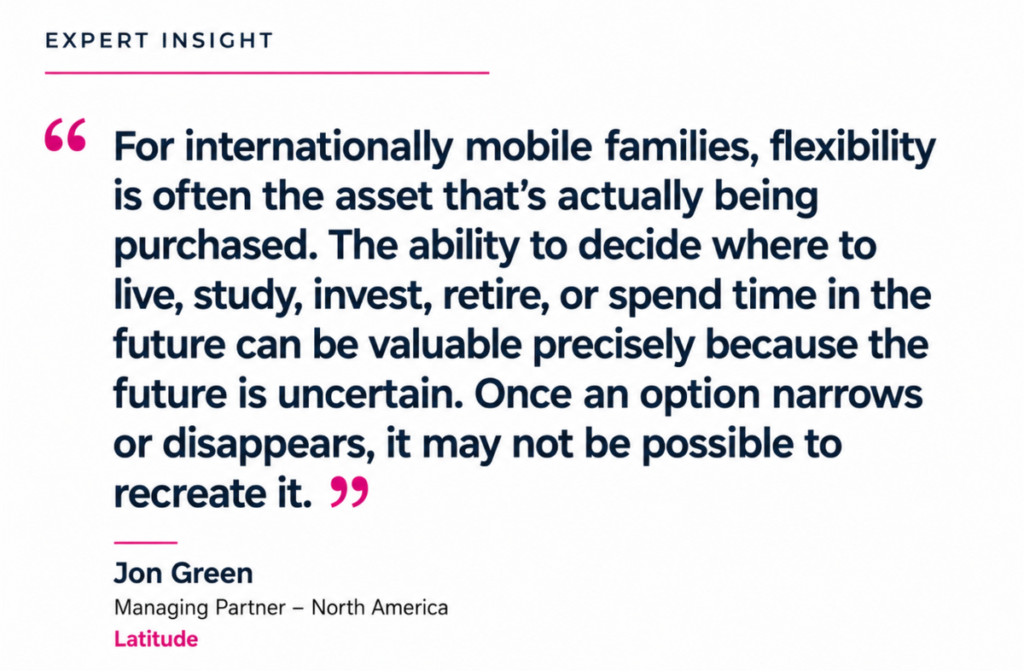
“For internationally mobile families, flexibility is often the asset that’s actually being purchased. The ability to decide where to live, study, invest, retire, or spend time in the future can be valuable precisely because the future is uncertain,” said Jon Green.
“Once an option narrows or disappears, it may not be possible to recreate it.”
Responsible Urgency, Not Alarmism
Residence and citizenship planning should never be driven by panic.
The decision to pursue a second residence, permanent residence, or citizenship pathway should be made carefully, with professional advice and a full understanding of the legal, financial, tax, and family implications.
However, responsible planning also means recognizing that opportunities are not guaranteed to remain open forever.
Governments can and do change the rules. Programs can and do evolve. The assumptions that shaped a family’s strategy five years ago may no longer apply today.
For that reason, the question is not simply: “Do I need this right now?”
A better question may be: “If the rules changed tomorrow, would I regret not having explored my options sooner?”
Considering Residence or Citizenship Planning?
If you are considering a second residence, permanent residence, or citizenship pathway, Latitude can help you assess the options currently available and determine which routes may align with your family’s objectives.
Our global team advises clients across a range of residence and citizenship solutions, including European residence, Malta permanent residence, New Zealand investor residence, Citizenship by Descent, and emerging developments within the investment migration landscape.

Speak with a member of the Latitude team to review your options under today’s rules and understand what may be possible for your long-term planning. You can view our contact details here, or book a complimentary (and obligation-free) initial consultation.
Frequently Asked Questions
Why does timing matter in residence and citizenship planning?
Governments create residence and citizenship pathways. As such, they can (and do) change over time. Investment thresholds may rise, eligibility rules may tighten, processing timelines may lengthen, or programs may close to new applicants.
Can residence and citizenship programs close?
Yes. Several well-known investor residence and citizenship routes have closed or changed significantly in recent years. This is why applicants should not assume that a current pathway will remain available indefinitely.
Does early planning mean I need to move immediately?
No. Many families pursue residence or citizenship planning to create future optionality rather than to relocate immediately. Early planning can help you understand your choices before you need to act urgently.
What can change in a residence or citizenship program?
Changes may include higher investment thresholds, new eligibility criteria, stricter due diligence, longer processing times, revised family inclusion rules, additional residence requirements, changes to the pathway toward permanent residence or citizenship, or the removal of previously available qualifying investment options.
For example, Portugal’s Golden Visa once allowed applicants to qualify through real estate investment or passive capital transfer routes such as bank deposits.
Which countries have changed their investor residence or citizenship rules?
Recent examples include Spain, Ireland, the United Kingdom, Canada, Greece, Portugal, and Malta. Each changed in different ways, but together they demonstrate that global mobility pathways can evolve quickly.
Is there still value in residence and citizenship planning?
Yes. For many internationally mobile families, residence and citizenship planning are an increasingly important component of their estate planning and can support long-term flexibility, mobility, education, business interests, lifestyle planning, and resilience. The key is selecting the route that aligns with your objectives.
What is the best residence or citizenship option?
There is no universally best option. The right route depends on your nationality, family structure, goals, timeline, budget, tax position, relocation plans, and long-term objectives.
How can Latitude help?
Latitude can help you evaluate current residence and citizenship options, assess eligibility, compare jurisdictions, understand timelines and requirements, and determine which solutions may support your family’s long-term strategy.