 Back to News
 Jump to other articles:
- IN THE MEDIA: Latitude Features In Forbes
- Latitude Founding Member of International Consortium Appointed to Advise Argentina on Citizenship by Investment
- IN THE MEDIA: Latitude Features In FINTECH.TV
- Mistakes to Avoid When Relocating to Malta
- Naoero Citizenship by Investment: What Applicants Should Know
Malta’s Global Residence Program Is Changing: What Prospective Applicants Should Know

Share:



Malta has introduced important legislative changes affecting several of its special tax status regimes.
The Maltese Government has published the Individual Tax Program Rules, 2026, which will replace the Global Residence Program (GRP), The Residence Program (TRP), the Malta Retirement Program (MRP), and the UN Pensioners Program for new applications submitted from January 1st, 2027.
The four existing programs are not being abolished in substance. Instead, they are being consolidated into a single legislative instrument with harmonized administration, while preserving distinct eligibility criteria for each.
As part of these changes, Malta’s Global Residence Program is set to change significantly for new applicants from January 1st, 2027. Existing GRP beneficiaries, as well as GRP applications received by the Malta Tax and Customs Administration by the end of 2026, will be covered by transitional provisions until 31 December 2031.
For internationally mobile individuals and families considering Malta as a tax residence base through the GRP route, the months ahead present an important planning window. While the core tax treatment under GRP will remain attractive, future applicants will face higher minimum annual tax requirements, increased property thresholds, a higher application fee, and a new five-year renewable status structure.
“Malta remains highly attractive for internationally mobile families, but the entry conditions are changing,” said Alexandra Kenna, Senior Advisor at Latitude.
“For individuals already considering the Global Residence Program, the period before the end of 2026 is important from a planning perspective.”
The changes form part of Malta’s wider move to consolidate several special tax residence programs under one umbrella framework – the Individual Tax Program. For third-country nationals who would currently apply under the Global Residence Program, the corresponding category under the new rules will be known as Global Resident Status.
What Is Malta’s Global Residence Program?
The Malta Global Residence Program, commonly known as the GRP, is a special tax residence program designed for individuals who are not nationals of the European Union, European Economic Area, or Switzerland, and who are not long-term residents of Malta and who are not beneficiaries under certain other Maltese special tax schemes.
The program is particularly relevant for internationally mobile individuals and families who want to establish a base in Malta while benefiting from Malta’s remittance-basis tax treatment and visa-free Schengen access (for up to 90 days in a 180-day period, in addition to an unlimited number of days in Malta).
Under the current GRP, qualifying foreign-source income remitted to Malta is taxed at 15%, subject to a minimum annual tax of €15,000. Foreign-source income that is not remitted to Malta remains outside the Maltese tax charge, while foreign capital gains are not taxable in Malta even if remitted, provided they are genuinely capital in nature.
Malta-source income is taxed separately under the applicable Maltese rules.
“The GRP has long been attractive because it combines residence in an English-speaking EU and Schengen country with a clear and established tax framework,” said Ms Kenna.
“For the right applicant, it can support lifestyle, family, business, and tax planning in a single jurisdiction.”
What Is Changing From January 1st, 2027?
From January 1st, 2027, the current GRP will be replaced for new applicants by the new Individual Tax Program framework.
The 15% tax rate on qualifying foreign-source income remitted to Malta will remain. However, several important requirements will be changed.
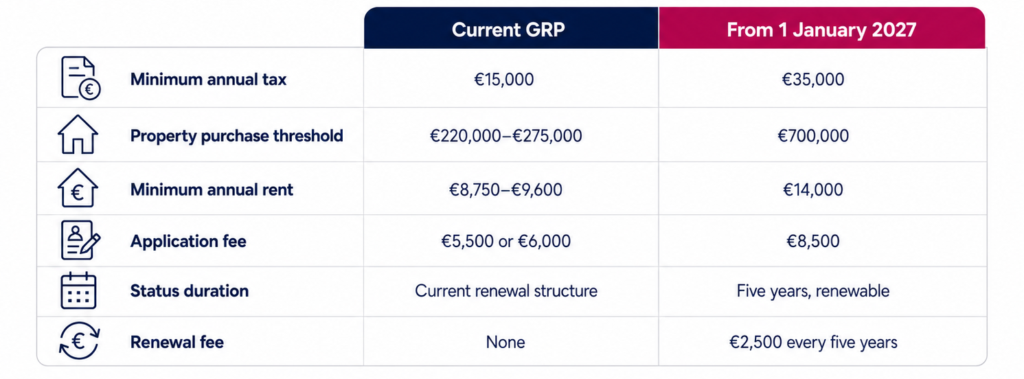
The most significant change is the increase in the minimum annual tax under the new Global Resident Status category. Under the current GRP rules, the minimum annual tax is €15,000. Applications received from January 1st, 2027 will fall under the new framework, under which the minimum annual tax for Global Resident Status will be €35,000.
Property requirements will also increase. The current GRP property purchase thresholds range from €220,000 to €275,000, depending on location. From 2027, the minimum property purchase threshold will rise to €700,000.
The minimum annual rent will also increase. Current minimum rental requirements range from €8,750 to €9,600, depending on location. Under the new framework, the minimum annual rent will be €14,000.
The application fee will also rise from the current €5,500 or €6,000, depending on the property location, to €8,500.
The new framework will also introduce a 5-year fixed-term structure for special tax status. Under the current GRP, special tax status continues subject to ongoing compliance and the applicable cessation provisions. Under the Individual Tax Program, special tax status will be granted for five years and may be renewed for further five-year periods, subject to continued eligibility and a €2,500 renewal fee.
The definition of a dependent will become narrower under the new rules. Parents, grandparents and dependent brothers or sisters will no longer qualify as dependents.
What Happens to Existing GRP Beneficiaries?
Existing beneficiaries of Malta’s Global Residence Program will not be required to transfer immediately to the new framework. Their current special tax status will continue until 31 December 2031, subject to ongoing compliance and the applicable cessation rules.
This transitional period is also important for prospective applicants. Applications submitted by 31 December 2026 will fall under the current framework and benefit from the existing conditions during the transitional period, subject to meeting all applicable requirements.
“Families who are already considering Malta should not leave the analysis until the final weeks of 2026,” said Ms Kenna.
“A proper GRP application requires due diligence, tax planning, documentation, property arrangements, and coordination with Maltese professionals and authorities.”
Why the 2026 Planning Window Matters
For some individuals and families, the difference between the current GRP and the new framework may be material.
Applying under the present rules may allow qualifying applicants to benefit from the current €15,000 minimum annual tax, lower property thresholds, lower application fee, more generous dependent eligibility and existing program structure during the transitional period.
However, this does not mean every prospective applicant should rush to apply.
Malta should be selected because it fits the individual or family’s wider objectives. These include lifestyle, tax residence, business interests, children’s education, property preferences, family mobility, healthcare, long-term residence planning, and many other factors.
“Tax should never be viewed in isolation,” said Ms Kenna.
“The right decision depends on the family’s broader circumstances. This includes income structure, residence plans, property needs, children’s education, future mobility objectives, and many other factors.”
Why Malta Continues to Attract International Families
Malta remains a compelling jurisdiction for internationally mobile families seeking a European base.
The country offers an English-speaking environment, EU membership, Schengen Area access, a Mediterranean lifestyle and climate, strong professional services, international schools, and a well-established legal and tax framework.
For many families, the appeal of Malta is not only tax treatment. It is the combination of lifestyle, legal certainty, business infrastructure, connectivity, and the reassurance of having a long-term base in Europe.
“Malta’s appeal has never been only about tax,” said Ms Kenna.
“It is an English-speaking EU jurisdiction with a sophisticated professional services ecosystem. It also offers a lifestyle that many international families find highly attractive.”
Who Should Review Their Position?
The changes may be particularly relevant for third-country nationals who are already considering Malta as a residence or tax planning jurisdiction.
A review may be appropriate for individuals and families who:
- Are already considering a move to Malta
- Want to establish a base or tax residence in an EU and Schengen country
- Have foreign-source income and require remittance-basis tax planning
- Are comparing Malta with other European residence options
- Want to secure a position under the current GRP framework before 31 December 2026
- Need to assess property, family, education, lifestyle, and tax residence considerations together
A private assessment can help determine whether the current GRP, the future Global Resident Status category, or another Malta residence route may be more appropriate.
Planning Before the Rules Change
The forthcoming changes to Malta’s Global Residence Program do not reduce Malta’s appeal as a residence jurisdiction. However, they do alter the financial and structural considerations for future applicants.
For individuals and families already considering Malta, the period before 31 December 2026 is an important opportunity to assess whether the current GRP framework is suitable before the new rules take effect.
“Applicants should use the time available wisely,” said Ms Kenna.
“The key is not to rush, but to review eligibility, documentation, tax position, property requirements, and timing while the current framework remains available.”
Speak With Latitude
Latitude works with internationally mobile individuals and families seeking residence, citizenship, tax residence, and long-term mobility solutions across Malta and other leading jurisdictions.
Those considering Malta’s Global Residence Program should seek professional tax and legal advice before making any decision. Latitude can help suitable clients assess the available options and determine whether Malta aligns with their wider personal, family, and financial objectives.
For more information, get in touch with Latitude Senior Advisor Alexandra Kenna on alexandra.kenna@latitudeworld.com. Alternatively, you can contact the wider Latitude team here.
Frequently Asked Questions
What is Malta’s Global Residence Program?
Malta’s Global Residence Program, often referred to as the GRP, is a special tax program for non-EU, non-EEA, and non-Swiss nationals who are not long-term residents of Malta. It allows qualifying individuals and families to establish residence in Malta while benefiting from Malta’s remittance-basis tax system.
Is Malta’s Global Residence Program changing in 2027?
Yes. From January 1st, 2027, Malta’s Global Residence Program will be replaced by the new Individual Tax Program framework. For third-country nationals who would currently apply under the GRP, the corresponding category under the new framework will be known as Global Resident Status.
What are the main Malta GRP changes from 2027?
The 15% tax rate on qualifying foreign-source income remitted to Malta will remain. However, the minimum annual tax, property purchase threshold, annual minimum rent, application fee, renewal structure, and renewal fee will all change for new applicants from January 1st, 2027.
What is the minimum annual tax under the current Malta GRP?
Under the current Malta Global Residence Program, the minimum annual tax is €15,000. From January 1st, 2027, the minimum annual tax under the new Global Resident Status category will increase to €35,000.
Can I still apply under the current Malta Global Residence Program rules?
Applications received by the Commissioner for Tax and Customs by 31 December 2026 will fall under the current framework. These will benefit from the existing conditions during the transitional period until 31 December 2031, subject to eligibility, compliance, and the applicable rules. Prospective applicants should begin the process early. This is because a GRP application requires due diligence, tax planning, supporting documentation, and property arrangements.
Who can be included in an application for Global Resident Status under the new Individual Tax Program Rules?
The definition of a dependent – a family member who can be included in the application – will become narrower under the new rules. Parents, grandparents, and dependent brothers or sisters will no longer qualify.
The following family members will qualify:
- the beneficiary’s spouse or a person with whom the beneficiary is in a stable and durable relationship;
- minor children, including adopted children and children in the care and custody of the beneficiary or their spouse or partner;
- children under the age of 25. This includes adopted children and children in the beneficiary’s care or custody, provided that they are not economically independent; and
- adult children who, because of a serious illness or disability, are unable to maintain themselves.
The dependents must satisfy other applicable conditions.
The new rules also recognize qualifying household staff, although they are not classified as dependents and remain subject to a number of conditions.
Should I apply for Malta’s Global Residence Program before the 2027 changes?
That depends on your personal circumstances. The current GRP framework may be attractive for individuals and families already considering Malta as a residence and tax planning jurisdiction. However, Malta should not be selected solely for tax reasons. A professional review can help assess whether the current GRP, the future Global Resident Status category, or another Malta residence route is more suitable.